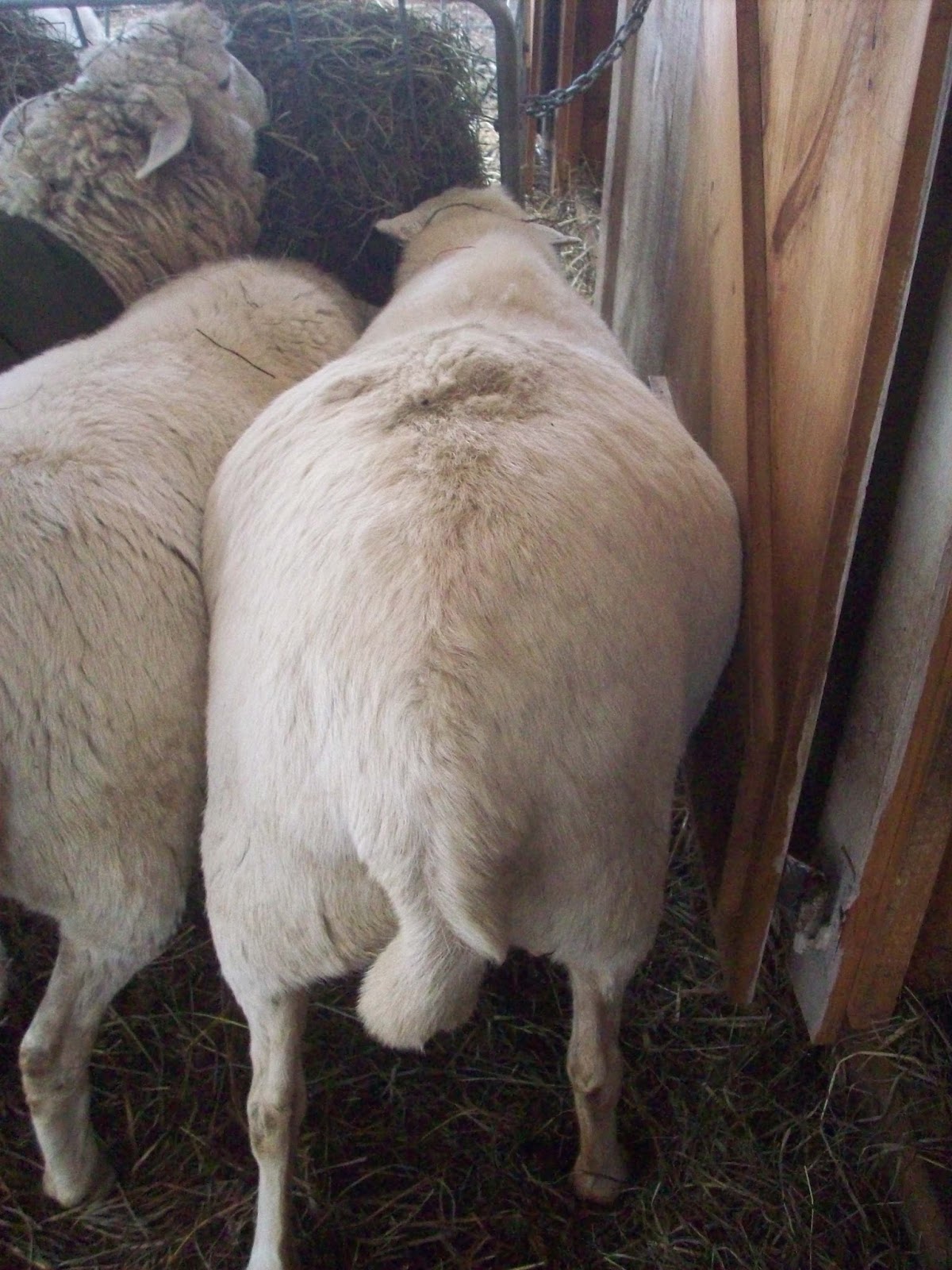
Moose came to us in late 2014 already bred. She delivered a 13 pound ram lamb in Late Jan. 2015. That ram lamb died when he was about one month old. The vets could never figure out why.
Fast forward to this year's lambing season. Moose was due on 2/28. Finally on the evening of March 2nd she went into labor and delivered a large ewe lamb, 12 pounds, with a little pulling help from me. (She also needed a bit of help pulling out her lamb in 2015.) Mama Sadie was still not letting her ram lamb nurse so we tried grafting him onto Moose after her ewe lamb was born. Moose seemed very excited to have two lambs at first and even let him nurse. But then she decided she had enough and wanted nothing more to do with him. I even tried putting my hand in her vagina to stimulate the pressure of giving birth but she would not have it. By now a couple hours had passed and Moose showed no more signs of having anymore lambs. The quick check when I had my hand in her vagina felt like a cavernous nothing. She was nursing her ewe lamb well and drinking water and eating hay. I was disappointed Moose only had one lamb, she was huge and I thought she would have at least twins, but at least she was healthy. I moved the ram lamb back in with his family and took a couple steps backwards with Mama Sadie accepting him since he now smelled like Moose and her ewe lamb.
At the overnight checks Moose and her ewe lamb were doing fine and Mama Sadie was getting better with letting her ram lamb nurse. It wasn't until around 1PM, over 14 hours from the time she delivered her ewe lamb, I noticed that Moose looked like she was pushing. She still had placenta hanging from her vulva so I figured she was just trying to pass that. I gloved up to see what was going on an found a lamb lying with its back towards Moose's belly way down in her uteruss, but head and front legs pointing towards the way out. Lambs don't bend that way and need to have their backs aligned with the ewe's back for delivery. I attempted to spin the lamb so its back was in the proper alignment but it would not budge. I also thought it had died since I had a finger in its mouth and felt no movement. After only attempting for a brief minute or two I figured I needed to have the vet on his way since I didn't think I would be able to get this lamb out. Moose also felt very warm inside so would need antibiotics and oxytocin.
Dr Dickerson got to the farm in just under half and hour. Even he had a good bit of trouble getting this lamb rotated and out. Even the hips got stuck. It was a 15 pound ram lamb and he did not respond to any resuscitation efforts.
Dr Dickerson gave Moose antibiotics, oxytocin, some vitamins and steroids and banamine for pain. She was having rasping breathing by now and looked exhausted. In the evening she developed a nasty cough along with her raspy breathing and I feared she was getting pneumonia. Thankfully, by 3AM her breathing sounded much better and she was coughing only occasionally. This morning she looks a lot better, still tired, but has a perkier look about her. So now I need to figure out Moose's future. She is a good mom once she is delivered but she has never delivered unassisted. And now I know I need to take the plunge and explore the uterus more fully if I think there is a chance there could be another lamb.
Showing posts with label animal doctoring. Show all posts
Friday, March 4, 2016
Monday, February 29, 2016
And the Fun Has Begun!
Mama Sadie spent a good part of yesterday standing around and rocking back and forth on her hind legs. At 10PM last night more of the same. At 12:30 she looked a little wet on her vulva but was acting totally normal, and she tends to get everything wet when she pees. So I went to check her again a little after 3AM. As I walked up to the barn I could hear that sweet nickering sound that new moms make to their newborns. Sure enough there were two wet lambs struggling to get up and placenta hanging out. I ran back to the house to get my lambing kit and towels and when I returned I saw a third lamb lying very still in the hay. I tried to resuscitate it to no avail. There was a little meconium on it and not so much on the other lambs, but Mama was doing a fine job licking her lambs so I don't know how much meconium there really was. I don't think the lamb ever took a breath since amniotic fluid poured slowly from its mouth.
Mama was very intent on cleaning off her babies, but not so much on letting them nurse. Each time a lamb would move towards her udder Mama would bat them away with her head. After the lambs attempted many times I finally haltered Mama and let the lambs get their colostrum. They were so happy to nurse and their little tails went crazy.
Once the lambs had nursed I needed to move the new family into a jug since where they were now was the section of pen I was going to fence off for my third jug and I have two other ewes who should be lambing any hour now. Mama wanted no part in following her lambs and just kept looking for them in the pen. I tried bribing her with some grain and that didn't work. Finally, with one lamb in my arms and the feed scoop, Mama saw a barn cat come into the barn and followed us with no problem. Did she feel threatened by the cat and moved to protect her lamb?
In the jug, a smaller space I was hoping would work better for nursing, Mama still would not let her lambs nurse. Out came the halter again. Mama had a nice drink of warm molasses water and some grain and hay and everyone was tucked in. The lambs found the heat lamp right away.
When I went back two hours later to check on everyone Mama had delivered the rest of her huge placenta and was laying in it. The lambs were crying to eat and I could not get Mama to get up no matter what. Back into the house worrying about milk fever. Grabbing the calcium gluconate and needles and syringes I ran back up to the barn to see Mama Sadie standing there looking at me like nothing had ever been wrong. Still she wouldn't let the lambs nurse so it was back to the halter. The lambs, a ram and a ewe, nursed for a good 10-15 minutes without much direction. Once their bellies were full the halter came off and the lambs went back under the heat lamp. I hope Mama figures out how to let her lambs nurse, she has had at least one other pregnancy and raised up two good sized lambs when we purchased her. So I know she can nurse.
Triplets explains why Mama Sadie was so big. She had 33 pounds of lambs inside. The ram lamb weighed 12 pounds and both ewe lambs weighed 10.5 pounds (yes I weighed the stillborn lamb.)
Thursday, February 11, 2016
Beyla
Beyla came to us in November of 2014 with her two-day old twin ram lambs.
One lamb was very ill and nearly died but was able to be nursed back to health and grew up to be an impressive butcher lamb like his brother. Beyla had horrible feet and had multiple abcesses on her nose last spring. I planned to cull her last fall but then gave her a reprieve, remembering what a great mother she was. It took multiple sessions but her hoofs improved greatly. She still had some cracking in the hooves and limped occasionally though. Her limping became worse over the past month, would improve with treatment with zinc sulfate, then worsen again. Last week her back left hoof was very sore looking, smelled bad, and I feared she was getting hoof rot. It's been really wet first with rain and warm temps then the 2+ feet of snow. All the sheep were moved into the barn, blocking all access to the outside pen, and Beyla was quarantined. I've been treating her hoof with zinc sulfate, a dilute bleach solution, a coating of LA200 (oxytetracycline) and packing it with iodine/sugar soaked gauze. The hoof looks so much better and she is only limping a little. I need her to be able to raise her lamb(s) to weaning then she is off to the butcher. Unfortunately, she is more of a liability than an asset at this point.
All of the research time I've spent on Beyla has reminded me of the works of Pat Coleby and her mineral supplementation. I have ordered the minerals and need to get some multiple compartment troughs for the barn and something to put the separate containers into in the pasture. Her theory goes something like this: a sheep (or any animal) knows instinctively what minerals they are lacking and will choose the appropriate ones given the choice. Pat recommends keeping six compartments with a single mineral in each. Copper sulfate, sulfur, seaweed meal, dolomite, salt, and ground limestone are a sheep mineral buffet. I was very interested in reading about sulfur's use in improving skin and fighting lice; maybe it will help Moose's mites and itchy skin. I am still debating the copper sulfate. The research on copper boluses is encouraging and our Coopworth yearlings, Hazel and Ruth, came from a farm that used the boluses. I haven't yet found any information on offering copper sulfate supplements when using copper boluses, so I don't think I will offer copper as a supplement if the sheep are getting copper wire boluses.
Tuesday, February 9, 2016
Getting Ready for Lambing
Our second season of lambing feels so much more prepared than our first lambing season. First off I actually know when the ewes were bred therefore I can calculate due dates. Once I have due dates I can plan for all those things a shepherd does before lambing; like worming, booster vaccines, etc. The older hair sheep are all due from Feb 27th to March 5th. Clara, our hair sheep yearling is due March 23rd and our Coopworth yearling ewes are due the second half of April, if they are pregnant.
The hair sheep are all looking very pregnant and their udders are beginning to swell.
Mama Sadie, our hair sheep cross, is absolutely HUGE! She came with two-month old twin lambs when we bought her so we never saw her pregnant. She has to have at least twins in there now.
From left to right above: Mama Sadie, Clara and Chloe (Clara's mother.)
The older ewes received their CDT booster vaccines last week and had FAMACHA and body condition scores this morning. All the hair sheeps' FAMACHA scores ranged from 3-4. Chloe was nearly perfect with a FAMACHA score of 4 and a body condition score of 3.5. Lucky girl got a pass on the worming. The other hair sheep had either a 3 for their FAMACHA score or were a little low on the condition score so were dosed with levamisole. Poor Clara got both the wormer and the CDT booster.
Last year I could not have imagined doing all this work by myself. But the sheep have become more used to me and I have gotten so much better with handling them. They, and I, are getting used to using halters. Most of the sheep stand still and put their heads down as soon as they feel the halter going on. All the conferences and classes are starting to paying off.
The Coopworth sheep have an appointment with the shearer in March and will have their booster vaccines, FAMACHA and body condition scores, and hoof trimming done at that time. It will be nice to compare my scores to the shearer's to see how I am doing with my accuracy. Still so much to learn!
The lambing tray is getting restocked, out dated items thrown away and replaced, and everything organized. I have a huge pile of old towels from cleaning out my husband's aunt's condo. The last thing we need to do now is set up a couple lambing jugs and wait.
Sunday, October 11, 2015
More on the Cornell Sheep and Goat Symposium
The Cornell Sheep and Goat Symposium was much more than the necropsy workshop. After the necropsy workshop we decided to split up and my daughter attended a pasture workshop; unfortunately she didn't learn much new information. I went to a sheep/goat skills workshop and learned how to tip a sheep (something I have been wanting to learn for a long time.)
Other topics covered included hoof trimming (I passed since I just trimmed all my sheep's hooves 4 days before), collecting manure samples directly from the rectum, giving boluses, ear tagging and tattoing, and a hay evaluation area. I was glad to get hands-on training in collecting the manure samples since waiting around for a sheep to poop is time-consuming and I wanted to make sure I didn't hurt the sheep. But really, collecting a sample was pretty much the same as doing a vaginal exam on my patients. And I learned that I will NEVER tattoo my sheeps' ears.
The hay evaluation segment was very educational. There were multiple samples of hay that had been analyzed for nutritional values of crude protein, total digestible nutrients, calcium, phosphorus, magnesium, sodium, potassium, iron, zinc, copper, manganese, and molybdenum. Calculating digestible dry matter and neutral detergent fiber (total structural fiber) were also covered. Surprisingly, the worst looking hay had the highest nutritional value.
So you can't tell how nutritious your hay is accurately without submitting samples to a lab for analysis. This link has directions to make your own hay core sampler using an old golf club. I am not sure if the few sheep I have and the multiple hay sources I use would make it worthwhile to have the hay tested.
Friday was packed full of great hands-on learning. Saturday was more lecture oriented, but I was able to attend the hands-on worm egg counting workshop. The FAMACHA course my daughter and I took at Delaware Valley Ag College just showed how to make the slides. I learn best if I do something with someone explaining as I go. This workshop was perfect. My sample had 29 Strongylid eggs in the two sections of the McMaster slide which calculates to a total worm egg load of 1470 per gram of feces. Fascinating! There were also coccidia oocysts in my sample too. They also gave us a handy laminated page with multiple microscope images.
I think the worm egg counting workshop was the highlight of the symposium for me.Now I just need to get a microscope and some McMaster slides.
Monday, October 5, 2015
Cornell Sheep and Goat Symposium
I love learning new ideas, techniques, anything. A day without learning something is a wasted day. I heard about the sheep and goat symposium nearly a year ago and have been waiting patiently. My daughter and I went up for the Friday and Saturday sessions. I am thinking we should have stayed in Ithaca for the farm tours on Sunday, but we really did need to get home.
The conference was great! We started with a necropsy workshop (now I found out last year it was a hands-on field necropsy, I would have loved to participate in that.) Cornell has a great little ampitheater for dissections. The veterinarian doing all the demonstrating, Dr Mary Smith, was a great teacher.
Here she is holding up a goat placenta. Those round red discs on the clear membranes are the cotyledons (a human placenta is made up of 15-30 cotyledons closely spaced.) The cotyledons attach to the caruncles inside the uterus.
Above is the inside of a two year old ewe's uterus. The caruncles are the white blob-like things. This is so different from a human placenta and uterus.The structure of the uterus is more like a cat uterus than a human uterus.
The last animal dissected during the necropsy demo was a two year old ewe Dr. Smith had just euthanized that morning. The ewe had been ill for a while, been on antibiotics but wasn't getting any better and had stopped eating. Then her one eye began to bulge out. It was interesting to see the antibiotic residue in the ewe's tissues. None of the internal organs gave any clue as to what ailed the ewe. It wasn't until the head was sliced in half down the middle that the answer became apparent.
This ewe had a large tumor in her sinus cavity and was unable to breath and eat, so breathing won.
I am really glad we went to the symposium and I hope it works out that we can attend next year. I will have another post about the rest of the symposium soon.
Saturday, September 5, 2015
The Last One
Yesterday I caught the last of the kittens and took him to get neutered. It only took two weeks to catch all the outside cats and get them neutered. No one entered the trap who had already been neutered. I spent a total of $120. There was a $25 deposit for the two traps (which I gave back as a donation), $20 for each cat and an extra $15 for the mama cat's distemper shot (which was included in the price for the kittens.) We had one female kitten and two male kittens.
No not me!
The mama cat has not wanted anything to do with her kittens since she came back from her surgery. She hisses at them and chases them away. She has also become more vocal and likes to hang out with us when we are outside. All-in-all that was a very well spent $125!
No not me!
The mama cat has not wanted anything to do with her kittens since she came back from her surgery. She hisses at them and chases them away. She has also become more vocal and likes to hang out with us when we are outside. All-in-all that was a very well spent $125!
Saturday, August 29, 2015
Soil Fertility
A couple weeks ago I sent soil samples from the vegetable garden, the orchard, the lower pasture and the hilly pastures to the Penn State Agricultural Analytical Services Laboratory. The results were somewhat as I expected and a little surprising in other areas.
This is the report for the vegetable garden:
Apparently the soil is perfect in the garden. All they recommend is an application of a 10-10-10 fertilizer. I think I'll stick with compost and composted manure.
The orchard is almost the opposite of the vegetable garden; every value is below optimum. The pastures were not too bad. They just need lime, only 6,000 pounds! I've been reading up on liming pastures and found out you shouldn't put that much lime down at once. Usually half is spread one year then the other half the next year. That's great, I only need to spread 3,000 pounds now. That's only 150-50 pound bags. Most farmers have a truck come in and spread lime and it's not expensive. But I don't think a truck could get into my pastures with all the fences, gates and hills. We are still figuring out the best way to do this but we need to come up with something soon since the lime should be spread before the reseeding.
The most surprising result though was the selenium. I paid extra to check selenium levels and they are more than double the top of normal for this area. I guess I don't need to worry about selenium deficiency in my sheep. The risk of selenium toxicity is something I need to think about. Chronic toxicity may take a while to show any symptoms but so far the sheep are doing fine on the pasture and have no signs of selenium toxicity. I can send a whole blood sample to the lab for selenium level for $25 or I can send a liver sample and get results for calcium, cobalt, copper, iron, magnesium, manganese, molybdenum, selenium, and zinc for $34. Since I will be butchering a couple of rams soon I think the liver sample is the way to go. I need to know if the selenium is just in the soil or if it is being taken up by the plants and eaten by the sheep.
Sunday, August 23, 2015
The Neutering Has Begun!
The local trap/neuter/return special until the end of September is $20 for neutering, rabies vaccine, worming, flea treatment, ear cleaning, ear mite treatment. And they tip the ear and tattoo a green line down the incision. I got two traps on Friday and caught one of the kittens this morning to take advantage of the no appointment, walk-in with one feral cat at the Allentown location today.
Everyone at No Nonsense Neutering has been really helpful. They gave great instructions for after care as well. Here is poor Tabby on the ride home.
She is up in the barn stumbling around in her cage waking up from the anesthetic. They recommend keeping females in the cage for 48 hours so they don't hurt themselves. I am hoping to catch Stumpy Tuesday morning to take her to the next walk-in day. But one of the other kittens would be fine too.
Saturday, August 15, 2015
Quarantining the Quarantined
Poor Hazel had been limping occasionally since we got her. On Thursday she began to limp more often than not, was grazing on her front knees, and was laying around a lot. Alan and I were finally together and caught her to look at her hooves. Both her front hooves were a little over grown and had an area of redness and irritation and a smelly yellow/gray discharge between her toes. We trimmed up her hooves and treated her with a zinc sulfate solution. She got a repeat treatment yesterday and then today I trimmed her hooves again; then put a gauze pad soaked in zinc sulfate solution between her toes and put a small baggy with the zinc sulfate solution over each hoof. Then I wrapped each baggie in livestock wrap and loose duct tape. She is soaking now and due to have everything removed after one hour.
She looks very stylish in her little make-do treatment booties.
Yesterday I worked 16 hours so her treatment was done by my husband and daughter. I had not seen her hooves since my original examination 2 days ago. I was relieved to see great improvement. No more odor, no more redness, no more limping.
All the reading I did about foot scald and foot rot on the internet was very pessimistic. Hazel's symptoms were similar to foot scald, except for the odor. Though with her rapid recovery I am hopeful it is just foot scald. She is not very happy being separated from her buddies so I will probably let her out of the barn tomorrow. But this has allowed us to have some "quality bonding time." And I was able to get a good assessment of her condition. She must have not been grazing well for a while as she is very thin. I can now get her supplemented so she can improve her condition score.
Some helpful websites:
http://www2.ca.uky.edu/agc/pubs/asc/asc129/asc129.htm
https://www.extension.purdue.edu/extmedia/As/As-596-footrot.pdf
http://agriculture.vic.gov.au/agriculture/pests-diseases-and-weeds/animal-diseases/sheep/footrot-in-sheep/footrot-in-sheep-2.-diagnosis
https://pubs.ext.vt.edu/410/410-028/410-028.html
Great post about using LA200 and DMSO to tx foot rot
https://colliefarm.wordpress.com/2011/11/03/foot-rot-fight/
http://www.farmfoodcare.org/pdfs/animal-resources/sheep-foot-rot-june-2010.pdf
Monday, July 6, 2015
It's a Sheep Chair
Our sheep came with horrible hooves. The vet worked on them twice but they still needed a lot of work. Holding the sheep and trying to trim their hooves didn't work (they are still a little wild.) Enter Premier's "Deck Chair." This thing is great. It was easy to put together and held the sheep well. The only problem we had was due to the fact that our sheep are various sizes. The smaller the sheep, the more it was able to struggle in the chair. Our largest sheep, Mama Sadie, sat there just as calm as could be.
We were also better prepared for some serious hoof trimming. The spray bottle of soapy water and a good stiff brush made it so much easier to see what we needed to do. The second pair of hoof trimmers, bought when I couldn't find the others, made it possible for Alan to do their front hooves while I worked on their back hooves.
Before cleaning:
After cleaning:
After trimming
Their hooves still have a lot of cracking and flaking and some pockets. I have read about increasing the copper in their mineral to improve their hooves. Must do more reading about that. At least we have no more "elf hoof" sheep.
A quick injection of the second CDT and it was a tip out of the chair.
Definitely a good purchase.
We were also better prepared for some serious hoof trimming. The spray bottle of soapy water and a good stiff brush made it so much easier to see what we needed to do. The second pair of hoof trimmers, bought when I couldn't find the others, made it possible for Alan to do their front hooves while I worked on their back hooves.
Before cleaning:
After cleaning:
Their hooves still have a lot of cracking and flaking and some pockets. I have read about increasing the copper in their mineral to improve their hooves. Must do more reading about that. At least we have no more "elf hoof" sheep.
A quick injection of the second CDT and it was a tip out of the chair.
Definitely a good purchase.
Friday, April 10, 2015
FAMACHA Training
Wednesday evening Maddy and I went to a FAMACHA training class put on by Penn State and held at the sheep barn at Delaware Valley University. FAMACHA is a diagnostic tool useful in determining which sheep/goats need deworming. The program is based on assessing the color of an animal's mucous membranes (mostly the lower eyelid) using a patented color card to diagnose anemia. Anemia is very helpful in assessing for barber pole worm infection.
The barn itself was impressive. There were at least three different types of sheep (we didn't go through the whole barn) and I was able to get some pictures of the hay mangers I want to build.
Side view-
The course started with a power point presentation covering internal parasites, their life cycles, management techniques to prevent the spread of worms, etc. Dr Wolfgang, from Penn State, spoke in a little more depth on other principles of management including refugia and Targeted Selective Treatment (TST.). Refugia is the term for populations of worms in untreated sheep and the subsequent larvae on pastures. Leaving worms that have not been exposed to the anthelmintics helps to reduce build up of resistance to wormers by diluting the numbers of worms that survive treatment. Another part of TST is FAMACHA scoring.
We then went over to the sheep and assessed the color of the mucous membranes of the lower eyelid of a sheep.
She was very cooperative!
Inside the classroom the assistants had been busy preparing fecal egg count slides from the fecal samples the participants brought. They also showed us how to prepare samples ourselves. Of course my sheep sample was the only sample with worm eggs, 1750! At least the goat sample I brought was clean. Dr Wolfgang gave some recommendations for treatment and I'll be getting the vet out, again.
I have been mulling over in my mind how to do my own fecal egg counts. It is recommended to keep a "low background parasite burden" and only treat animals when necessary i.e., if becoming anemic. This strategy should help decrease the development of resistance to anthelmintic drugs. But having the vet's office do routine fecal egg counts on all my sheep and goats on a routine basis could get expensive. Preparing the sample is not that difficult and only requires a few simple tools. The most costly tool is a microscope. I am spoiled by the microscopes at work so a cheap microscope might just be too frustrating for me.
All in all it was a great class and we learned a ton of very useful information. When I look back to what I knew about sheep four months ago I see huge growth, but there is still a long way to go.
Saturday, March 14, 2015
Lambing Clinic
Today my daughter, Maddy, and I went to a lambing clinic. It was great to spend the day with other sheep people and talk lambing. I think my education up to this point was at just the right level to get the most out of this class. Nothing seemed to go over my head and I was never bored. Some of the information reaffirmed things I was doing and I learned a lot of new ideas and concepts to add to my sheep husbandry. By midmorning my brain hurt!
While it was sad to see dead lambs, they were extremely educational. I was very interested in the necropsy demo that was on the schedule but just being able to see lambs used to demonstrate malpresentations was very helpful. It's hard to visualize how you would bring a leg around that was pointing backwards when you are just reading about it in a book.
Seeing the necropsy made me more confident to try one. A simple incision on the abdomen of the lamb moving towards the ribs then cutting through the ribs to open the chest cavity was all that is really needed. I just need to get some disposable scalpels. From the necropsy it was suspected that this poor little lamb was stepped on and died from internal hemorrhaging.
After lunch we all went back to the farm and saw demonstrations of ear tagging, weighing, taking temperatures, tail banding, etc. I even got to band a tail! While my Royal White sheep don't need their tails' docked, I might need to do this if I ever get any wool sheep. The process is the same for castration.
This little lamb was a teeny, tiny triplet born during the morning session. It looks a lot bigger here though:
All in all it was a great way to spend a damp March Saturday! Thanks to Caroline Owens for hosting and organizing the event and sharing her knowledge. Also a great big thank you to Dr. Jackie Rapp for imparting tons of her knowledge all morning; and to Jan Motter and Jerry McCarthy for sharing their expertise as well.
Tuesday, March 3, 2015
Sad Day
I went to check on the sheep for the evening and found ram 3 had died. He never did show much improvement after the second vet visit. He wasn't eating, wouldn't take a bottle and didn't seem to respond even to tube feedings.
Today he wasn't getting up, was breathing rapidly, and laying his head back on his chest. Every once in a while he would lift up his head and move it around. He must have just died before I went out since he was still warm.
His mother, Moose, was very upset when I moved ram 3 out of the pen. She is up there now pacing around looking for him and calling.
So, to find the good in all of this (I sure hope this gets easier as I don't think this will be the last time we have a sheep die) here are some things that I learned throughout ram 3's illness:
1. I have great vets. They come quickly in an emergency, are knowledgeable, and reasonably priced.
2. I found a great farm store, Weaver's Farm Supply near Fleetwood, PA. They have nearly every livestock healthcare supply item you could want at great prices. Better than Tractor Supply!
3. The dose of pennicillin for a 36 pound lamb is 1 ml.
4. No matter how hard it is to do, I must make sure a ewe is milked out if her lambs are not able to nurse.
5. I have gotten pretty good at tube feeding, although it helps greatly to have an extra pair of hands with a larger lamb.
6. I need a stanchion and a lamb creep. This site has some plans I am studying for ideas.
7. I need to learn to perform a necropsy. The vets had a couple of theories as to what ailed ram 3 and I do as well, but a necropsy may have given the answer. My daughter and I will be taking a lambing clinic on March 14th and there will be a vet demonstrating a necropsy. Hopefully, we will be allowed to take photos. So much to learn, so much to learn.
Saturday, February 28, 2015
Another Vet Visit
Thank goodness I have such great veterinarians. Ram 3 was doing much better Wednesday night and yesterday, but this morning he seemed to be going backwards. On the plus side he was passing a firmer stool, but seemed more listless and didn't seem to be eating as well.
So back out came the vet. Dr Dickerson was the vet on today and he was great. Ram 3's temp was normal, 102.3f. But he's looking a little dehydrated. The vet gave him an IV with an electrolyte solution and injections of Banamine, Vitamin C and Bo-Se (a selenium/Vitamin E supplement.) The Vitamin C was given to acidify the urine in case the ram has urine crystals. He left me 2 more injections to give for the next two days.
Watching Dr Dickerson giving the IV was very educational and very messy. Oh well, I wanted to wash my barn coat and pants again. It's very interesting to compare veterinary medicine to human medicine. I learn so much each time the vets come to the barn.
Wednesday, February 25, 2015
Ram 3 Update
Since Sunday ram 3 has been on penicillin, had two enemas and two tube feedings. Yesterday and today we saw him drink water but he is still not nursing. He strains and appears to be uncomfortable. The vet came out this afternoon to see him. She took a stool sample to check for worms and examined him. His temp was 104.7 (normal is 102-103.) She gave him three injections-a longer acting antibiotic, some Banamine (an NSAID), and some B vitamins. She also told me my dose of 0.4 ml of penicillin was underdosing him and in the future the proper dose would be 0.5-1.0 ml.
He seems to already be feeling better this evening. When I went out to feed he was sacked out and seemed to be sleeping peacefully between his two pals.
He woke up while I was feeding and nibbled at some hay. He is also tasting the sheep mineral and continues to drink water. He has tried to nurse but I don't know if he doesn't have enough energy yet or if there is just too much commotion. I split the big stall like I did for a lambing jug and put ram 3 and his mom alone in there. Maybe they need some alone time to get the nursing going again.
The vet, Dr Orndorff from Oley has been great. This is the third time she has been out since I got the sheep and I always learn so much from her. She left three doses of Banamine for the next three days so we can keep his fever, pain and inflammation down. I hope he is feeling better soon.
Sunday, February 22, 2015
Always Something to Worry About
I am finding with the sheep that as soon as I think things are going well something crops up. This morning ram3 was looking like he wasn't feeling well. He was laying down in the corner and was not interested when everyone else was eating.
He has no fever or diarrhea. I gave him a dose of penicillin in case he is brewing an infection and a drench of oil in case he has a bit of bloat (though his stomach is nice and soft but a little tender to palpation.) He has gone outside a few times today but the one time I saw him nurse he only sucked a second or two. His poor mama's udder is getting huge.
If he is not nursing by tomorrow morning I will have to milk her.
When Leda's udder became engorged right before lambing I noticed that her right teat was smaller than the left teat. Now I think I know why.
I didn't know if she had lambed before I bought her. I now think she did and she probably had mastitis in the right side of her udder. She obviously has no milk production going on in the right side. I guess it's a good thing she had a singleton. She may not be able to produce enough milk for more than one lamb. Now I have to figure out if she will get culled. Her personality is good but she has this ongoing skin issue and now her udder problem.
Saturday, February 14, 2015
Our Last Lambing of the Season
Leda's udder was huge this morning so we didn't think she would be pregnant for long. When we checked on her later in the morning she looked like she was having contractions, but nothing obvious was going on. I put up the fencing for the lambing jug and left her alone. When I checked on her about an hour later she had a big bag of water hanging out of her vagina. I had already brought my towels and tray of lambing supplies with me so only needed to call my husband and daughter up to the barn. Today is my husband's birthday so it was a nice little present.
Every lambing seems to have its little issues. With Leda it was the positioning of her lamb. The right leg and head were presenting but the left leg was no where to be seen. Despite that she seemed to be pushing well but I was watching the clock. Here you can see the lamb's head and neck but no left leg. The right leg is behind the lamb and not visible in this picture. At this point the lamb still had the membranes over it's head and began to jerk.
I was worried about the lamb trying to breath so went in to clean off the face.
At this point the left shoulder was out so I just helped Leda with the rest of the delivery. The lamb passed a lot of meconium during his delivery so he was stressed.
Just one ram lamb! I was so hoping Leda would have twins.
I was a little concerned that the lamb might have trouble with his left front leg, but he didn't seem to be bothered by it at all.
He took to nursing well. Leda has two very different teats, one is much smaller than the other, but he doesn't seem to be having any problems adjusting. A healthy 10 pounds of ram lamb. Ram5.
Wednesday, February 11, 2015
Our Second Vet Visit
Our second vet visit this afternoon was another round of sheep wrestling. I do think it went better than the first time though. Ram1's abscess was looking a whole lot better. The swelling and redness have gone done tremendously and there is just a little scab.
Beyla's abscess had begun to open and drain this morning. The vet lanced it and drained a lot of pus and blood, cleaned it up and gave her a shot of antibiotics. She still looks pretty pathetic! I had the vet take a sample for a culture just to make sure it's not Caseous Lymphadenitis, but she doesn't think it is. She thinks their immune systems are still down from their former home and everything should run its course. I hope she's right!
Moose and Chloe had their hooves trimmed. Moose's hooves were horrible, like elf shoes! Chloe was very good about having her hooves trimmed and the vet said they were much better than the others. Everyone got another shot of Ivermectin because we still have some itching/scratching going on. Leda looks like she is due in about a week or two so she did not get treated. The vet left me with a dose to give her after she lambs. She thinks their intermittent runny noses are a virus that also needs to run its course and agrees that the occasional bloody noses are from irritation. We are hoping Spring and grazing sets everything right.
Earlier this evening when I went to feed the goats Brigid was not eating and didn't look right. She was standing in the corner looking uncomfortable. She was very distended with her left side more so. I thought she might have bloat and sure enough all of her symptoms and physical findings agreed. Of course getting her to agree to the treatment was not so easy. I think I got enough olive oil into her and walked her around but she hasn't started passing gas yet. She didn't want me any where near her now so I figure if she's too good at getting away from me she must be improving. While I was giving Brigid her oil our other sheep, Mama Sadie, kept trying to get me to pay attention to her. She let me scratch her all over and asked for more. She has NEVER done that! Maybe she's finally getting tame.
Monday, February 9, 2015
Abscesses
I noticed this abscess on Ram1 last week.
Then a day or two later, I noticed this lump on the side of his mother's nose.
The abscess above Ram1's eye opened up soon after I took these pictures. It was all pus and blood. I saved a sample of the pus for in case the vet wants to run a culture but it will have been in the fridge for 3 days so I'm not sure they will be able to culture it. Of course I am worried about caseous lymphadenitis but the location of these abscesses seems all wrong for CL from everything I've read. The vet is coming on Wednesday and we'll see what they think. We are due for hoof trimming anyway.
Subscribe to:
Posts (Atom)