Showing posts with label cover crops. Show all posts

Friday, June 19, 2015

The Old Apple Tree

One of the apples trees that were planted by the previous owners of our property did not make it through the winter. When we moved the chickens out of the orchard Alan was able to cut up the tree and dig up the trunk. He said the roots were very mushy and limp.
Now I have room for more fruit trees.
Using the method I am employing with the other fruit trees, I should be able to get at least four more trees into this space.
First though, we need to level out all the holes the chickens dug.
I will cover crop the area with buckwheat throughout the summer, then sow a fall planting of oats. The oats will be killed in the winter, leaving a nice surface into which we can plant the trees in the spring. The cover crops will help build up the soil and keep noxious weeds from taking over the area this summer.
Now I just have to figure out what else I want to plant in the orchard.


Saturday, June 13, 2015

The Cover Crop Experiment Continues

The value in the cover cropping I've been doing should be seen in the planting results for this year. I have been a bit late planting this spring, but just about everything is now in the ground. It took me a while to figure out where to plant everything, harvesting then waiting for the cover crop to start to break down, and how to go about doing the planting in the cover crop.

Planting in the rye is definitely difficult. The time spent making and planting the rye in rows next fall will really pay off for planting in the spring. It was tough making furrows to plant seeds when the clumps of rye roots were randomly spaced around the patch. I had to rip out a few but I was able to get everything planted.

Here is the patch of parsnips planted in the rye. I am very interested to see how things go with weeds since hoeing would be very difficult, if not impossible in this patch.
The beets are a bit of an experiment. The first row on the left were planted last month: Chiogga variety. Next is another row of Chiogga, then a row of golden beets followed by another row of golden beets fully in the rye.
The last plot with rye is a large one with corn, beans and squash.  After seeing how difficult it is to dig furrows in the rye I decided to go with the old indian/colonist three sisters' planting method. I dug holes every two feet in a four by five pattern. Into each hole was planted five corn seeds, two louffa gourd seeds and two hyacinth bean seeds.
I had planned to plant the carrots in the rye as well, but thankfully the rye didn't quite go that far. One row of carrots has a small area of rye so I can have a very small trial. I really like Cindy Connor's method of planting carrots in between rows of rye. That will make a huge difference next year.

The last plot of cover crop to be planted was the pole beans. These are seeds I saved from the few plants I grew last year of a Thai bean I got from a friend at work (Thanks Na!) I ate only a few of the beans so I would have enough seeds to get a good planting this year. The pole beans went into the Austrian Winter Peas. The beans don't need the nitrogen from the winter peas but the garden is a great big puzzle when it comes to planting. When you take into account crop rotation and the large area that is too close to the old walnut tree it makes it hard to figure out the best place to plant everything.

One big improvement planting into the cover crop has shown is in water run-off. Most of my vegetable garden is on a slight slope so when I water often the seed will move downhill with the water. That didn't happen with the seeds planted in the rye.  So the experiment continues!

Thursday, May 28, 2015

Harvesting the Cover Crop

Sickle v scythe. The Austrian Winter Peas, approximately 12x12 feet, were harvested using a sickle I have had for years. The pea stem was pretty soft and cut well with the sickle. The main problem was the length of the sickle handle. I had to either bend way over or kneel to get a good angle on the cutting.

Then I tried a patch of winter rye, slightly larger than the patch of pea cover crop. The stems were much tougher and required a smaller "bite" with each swipe of the sickle. And I had to kneel for the entire patch.


Altogether it took me about 40 minutes to cut those two patches of cover crop using the sickle.


Then I cut the remaining patch of winter rye using the scythe. That patch was about 12x25 feet and took about seven minutes to cut down with the scythe. And I was able to stand the whole time! The definite winner is the scythe.


The sheep think the Austrian Winter Peas dried in the sun make a mighty tasty hay too.

Wednesday, May 20, 2015

Austrian Winter Peas

I spent some time on the internet trying to figure out when exactly would be the best time to cut down my Austrian Winter Peas. I read in a few places that the most nitrogen fixation occurs at full bloom. A few flowers have just begun to open so I will wait it out a little bit longer.
I found a great post about a "cocktail" mix cover crop of rye, Austrian Winter Peas, oats and Crimson Clover, vetch and lupines. The colors of everything blooming are just wonderful. Now that I know that the rye and peas bloom about the same time and the clover is still going strong with its bloom I definitely need to do some combo cover cropping.

Wednesday, May 13, 2015

Mid Spring Cover Crop Update

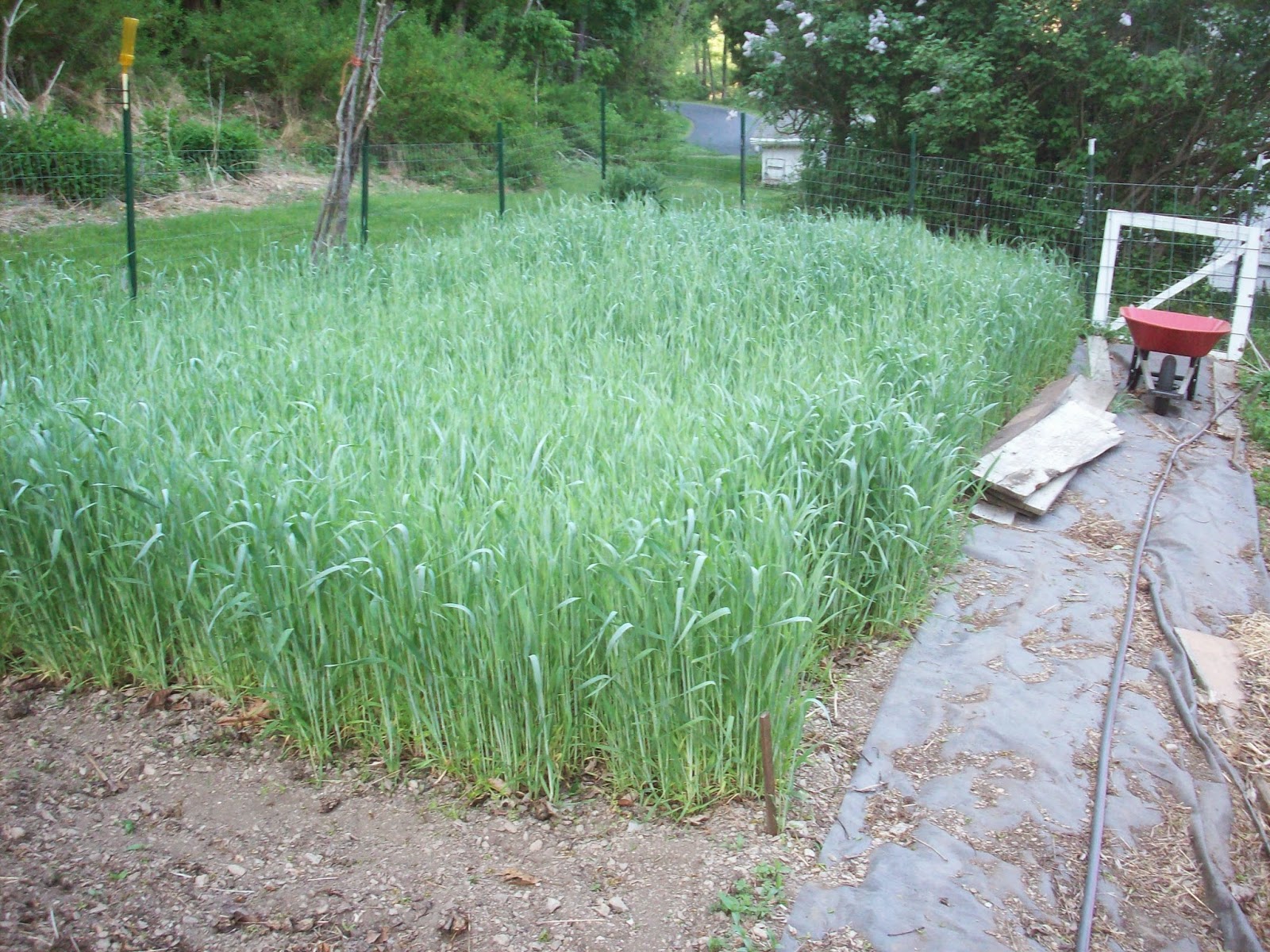
The cover crops have taken off! The winter/cereal rye is just about ready to cut.
The best time to cut is when they are shedding pollen. The rye is starting to make its flower so it should be shedding pollen soon.
Once the rye is shedding pollen it gets cut, then the roots sit for 2 weeks. I am going to try transplanting right into the decomposing roots as in Cindy Connor's book "Grow a Sustainable Diet".
I am very interested in the results and will post them here.

The crimson clover that made it through the winter is beginning to bloom as well.
According to SARE, crimson clover flowers are great food for many beneficial insects and do well interplanted with winter rye. I definitely need to think about some cover crop mixes next.

My poor maligned Austrian Winter Peas have really come on strong with the heat. And don't seem to be minding the lack of rainfall. I take back just about every negative thing I said about them before.
All in all I can safely say I am happy with the cover crops I have grown so far. I have a big bag of buckwheat seeds waiting for cover cropping and I will definitely be using fall oats and radishes in my garden this year.

Disclosure of Material Connection: I have not received any compensation for writing this post. I have no material connection to the brands, products, or services that I have mentioned. I am disclosing this in accordance with the Federal Trade Commission’s 16 CFR, Part 255: “Guides Concerning the Use of Endorsements and Testimonials in Advertising.”


Tuesday, April 14, 2015

April Cover Crop Update

As spring progresses I am getting a better idea how the cover crops faired over the winter and what I like and don't like about each one.

Crimson Clover:
Everything I've read says crimson clover should over winter in our area. But most of it died. The green plants at the bottom of the picture are what is left of the clover. We did have a very cold winter, with many days of record breaking low temps, but I can't count on that never happening again. So scratch crimson clover off the list.          
                               
Austrian Winter Peas:
These are my second biggest disappointment. I don't know if I planted them too late or not heavy enough but I am not happy with the sparseness of the planting. The gaps leave too much room for weeds to move in. If I try them again I will plant a little earlier and more thickly seeded.
Winter Rye:
This cover crop looks great. The plants are densely spaced, crowding out weeds. The final verdict will come in when I cut the rye, at pollen shed, and see how the roots die off.


Oats:
The oats grew nicely in the fall then died back into a nice mat that should be good for planting transplants. Definitely something to grow again.


Tuesday, April 7, 2015

Planting Onions

Ever since we moved to a place that has soil good for root crops I have fallen in love with growing onions and garlic. Onion seed planted in February has grown into nice seedlings ready to be planted outside. There is off and on rain forecasted for the next few days and today was sunny and 70 degrees so it was perfect onion planting weather! Now I have 240 onion seedlings in the ground.
In 2013 I tried a method of planting onions I read about in a book by Eliot Coleman. You plant 3-4 seedlings in the same hole, each clump about 6 inches apart. I had a great crop that year, but didn't know if it was from the new garden or the planting method. Last year I planted in the more traditional method and had more problems with weeds and a lesser harvest. It's definitely easier to hoe between the clumps than individual onion plants.

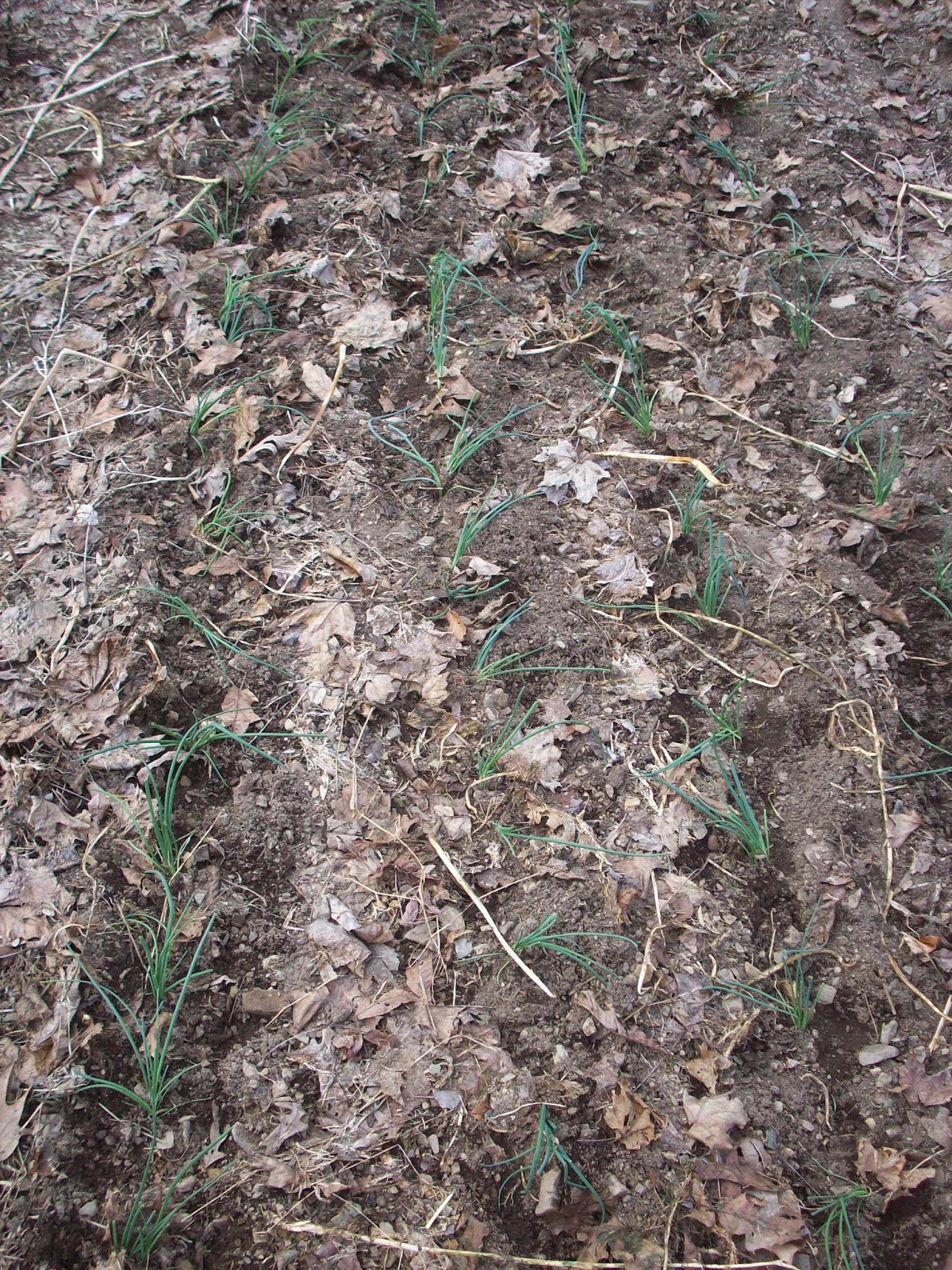
I planted the onions in the section of the garden that was planted in Daikon radish as a fall cover crop. Other than a few stems there is no evidence of the radishes, and some were over eight inches long and three inches in diameter! The soil was beautiful. All I did was hoe four furrows for planting the onions. This is the year for the no-till gardening trial.

Tuesday, March 17, 2015

Cover Crops at the End of Winter

Our snow has finally melted enough that I can see the cover crops in the veggie garden. The winter rye is looking no worse for wear after being under a foot or so of snow for a few months.
The Austrian Winter Peas are just becoming visible.
And some of the Crimson Clover looks like it took a beating under all the snow. We'll see how it recovers once the warmer temps are here to stay.

It will be great to get back to work in the soil!

Friday, November 14, 2014

Radish Cover Crop

The daikon radishes planted for a cover crop are doing very well, even though they are covered in a little snow now. Some of the radishes are getting to be quite large. Once the frigid winter hit those roots they will break down and are going to definitely add a good bit of organic matter to the soil.
And I guess if we were really craving radishes we could eat some too.

Wednesday, October 15, 2014

More Cover Crops

I am very happy with all my cover crops.  The crimson clover is coming up nicely:
The daikon radish and oats likewise are doing well:


We had a few days or rain which spurred on the germination of the newly planted Austrian Winter Peas and Winter Rye.

We pulled out the corn and readied another spot for more Winter Rye:
My hope is that the garden is as productive, for itself rather than my family, this fall and winter as it was during the spring and summer growing season.


Tuesday, September 9, 2014

Cover Crops part II

The oats are up! It took a while with the dry weather we've been having. Watering with a hose just never seems to do as well as a good rain. I've been waiting for rain and Saturday night we had a nice cool front move through, bringing thunderstorms and about an inch of rain. And then Sunday morning this is what I saw:
Literally overnight the oats went from nothing to nearly two inches tall.
The dwarf white clover I planted in some areas of the paths is up as well. I struggle with the paths in my gardens every year. Always the weeds get ahead of me.  This year I put down a weed block fabric, but I can feel the weeds growing up underneath. In the book, Grow a Sustainable Diet, the author just mows her paths for the compost pile. I think I will try that next year, if I can just get all the rocks out of the paths.. The dwarf white clover would be a perfect plant for the paths.