Have you ever really wanted to do something but just needed a confidence boost? That's how I was with dyeing. I have lots of books, have watched videos and read website and blog instructions. But still there was that feeling that I needed to actually watch someone dye from start to finish and ask all the questions that came up in my mind.
Saturday I took an amazing workshop at White Barn Farm in New Paltz, NY. I saw the pictures of a workshop done by Paula last year and had been looking for another one this year. The over 5 hour drive (round trip) was more than worth it for all the education and experience I gained.
Paula has an amazing space for dyeing that I can only dream of.
Paula taught us much more than I could have even hoped for in the short 5 hours of the course, and we all came home with amazing memories and beautiful mini skeins of samples.
Documenting what we were doing (so we would remember) was stressed and we made these notecards for reference.
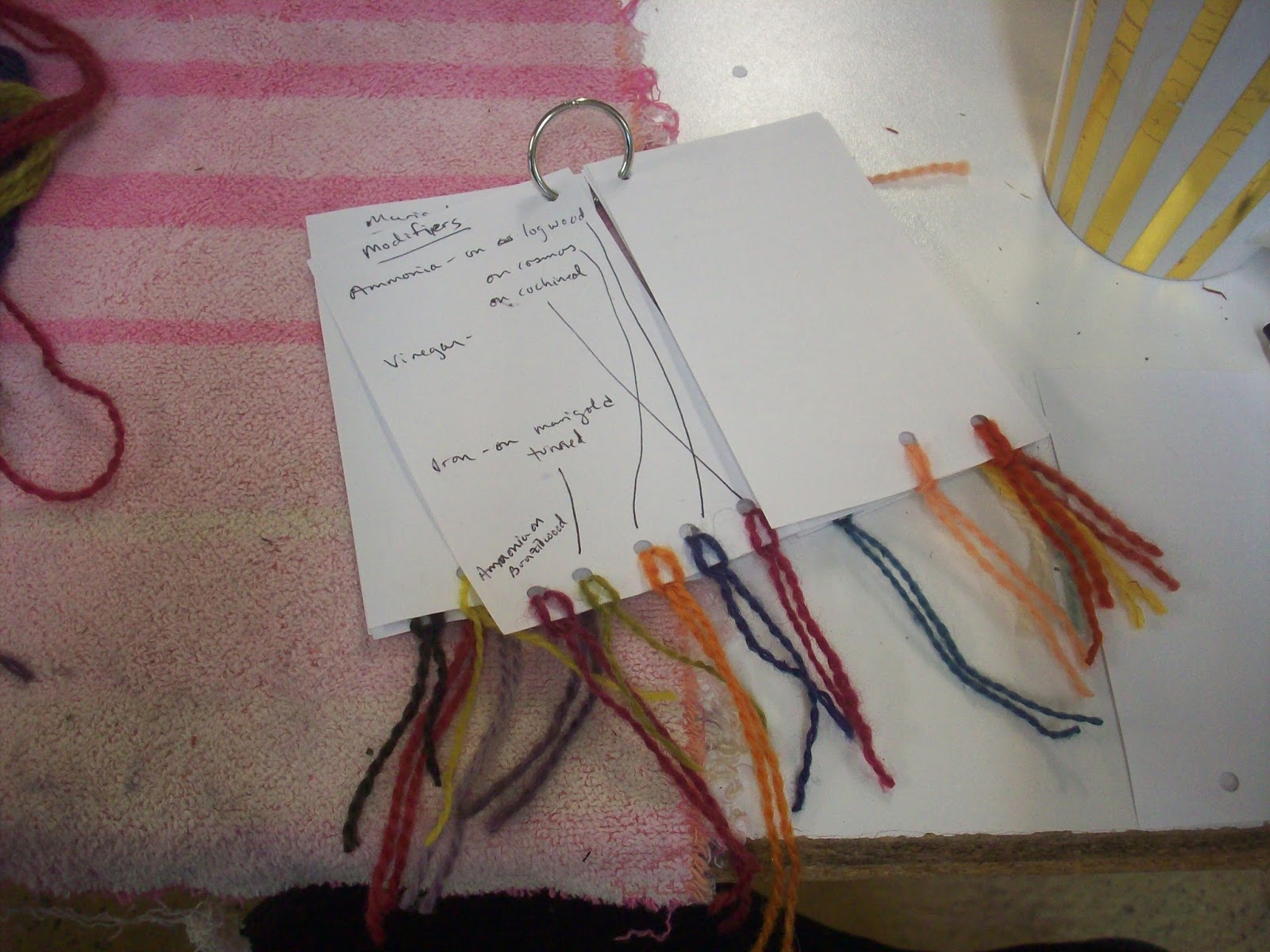
The day began, after getting a nice big mug of my favorite Earl Grey tea, with a discussion of mordanting with alum and cream of tartar. Paula had already started mordanting the wool we would be dyeing during the workshop. After splitting up our skein into ten mini skeins and marking them with different colored rubber bands (so we could tell ours from the others) we went out to look at Paula's dye garden and pick some leaves and flowers.
She had two nice patches of indigo.
One of madder (which needs to be three years old to harvest the roots. Unfortunately this patch was only on its first year.)
Then we focused on flowers; specifically marigolds and cosmos.
Back inside with our harvest from the garden, our first task was making a dyebath with fresh indigo leaves. A blender was packed full of leaves, then distilled water was added and the whole lot blended.
We added our mini skeins and waited. While waiting we went on to the indigo vat. This was just indigo powder, lime and thiox. The scum on top is removed when dyeing, and then replaced.
The color was at first a blueish green which quickly turned blue in front of our eyes.
The longer the skeins from the indigo vat were exposed to the air the darker blue they became.
The skeins dyed in the fresh indigo leaf vat also started out green then turned a beautiful pale blue with exposure to the air.
The skeins on the left, above, were dyed by us, the skein on the right had been dyed the day before with about half as many indigo leaves as we picked.
We made up three half gallon canning jars with madder root, brazilwood and logwood in a large canning kettle on a camp stove. Each jar received two tablespoons of the dye material and was a little over half filled with distilled water. The jars were the simmered in the water bath, then our skeins were added.
I can't remember if this was brazilwood or madder, but the colors were gorgeous!
We made another three jars with cosmo flowers, marigold flowers, and cochineal. The cochineal bugs are shiny little bugs that live on the prickly pear cactus in the southwest.
Two tablespoons of cochineal were added to a jar, and the flower heads were half or more filling the jars. The cosmos gave a yellow with a little more orange tinge while the marigold gave a clearer yellow.
One of the most interesting parts of the workshop was playing with the modifiers. An ammonia rinse gave the most gratification. The ammonia turned our deep purple/brown logwood into a lovely shade of blue with a touch of violet. The cosmo yellow became a vivid orange, and the ammonia brought out more of the reds in the madder. The iron modifier turned the marigold yellow into an olive green.
With all the knowledge I gained on Saturday I felt confident enough to play around on Sunday at home. I had a vat of soaking walnuts and over 30 skeins of Mercer's wool. After straining out the walnuts I simmered the dye on the Coleman camp stove I found in the basement from our modern camping days. Then I added the skeins. From all my reading I learned that walnut dyeing does not require mordanting, unless you want to change the end color.
In the first bath I dyed on skein for 10 min, one for 50 min and one for 60 min. In the exhaust bath I did the same with another three skeins. These were my results:
The exhaust bath skeins are on the right, above. The colors in real life are much richer than this screen shows. I put another two skeins in the second exhaust bath and will take them out after 24 hours. This is so much fun and I can't wait to try more colors!
Monday, October 3, 2016
Monday, September 26, 2016
Falling Trees
The state game lands surrounding our property routinely drop trees onto our property. Thursday night when I got home from work Alan told me about his near brush with having a dead tree drop on top of him. He was mowing the lawn and had just finished the little strip between a large clump of lilacs and the garden fence. He did a loop through the next portion of lawn and when he drove by that little strip, about a minute later, there was a large dead tree.
The tree missed the garden fencing and the lilacs and fell exactly in between. It crossed our barn access road:
And went up into the woods.
Alan thinks its ash and has been dead a while. The wood is ready for burning this season.
A few weeks ago another tree, a locust this time, fell out of the game lands and missed the barn and fencing.
This tree fell right between the barn and a jog in our pasture fence, damaging nothing. Once seasoned this tree will provide close to a cord of wood.
The tree missed the garden fencing and the lilacs and fell exactly in between. It crossed our barn access road:
And went up into the woods.
Alan thinks its ash and has been dead a while. The wood is ready for burning this season.
A few weeks ago another tree, a locust this time, fell out of the game lands and missed the barn and fencing.
This tree fell right between the barn and a jog in our pasture fence, damaging nothing. Once seasoned this tree will provide close to a cord of wood.
Monday, September 19, 2016
Sheep Updates
Lots of sheepy updates from the past couple days. Saturday morning I found Moose in with the rams. She went through two sets of electric fence and a stream to get there. She looked very happy and Elwood had definitely claimed her.
Sunday we took Rufus up to his new home so we moved everybody around. Moose went into a breeding group with Mercer, Mama and Ruthie. And Elwood's new girlfriends are Hazel, Clara and Chloe. Rufus and Clementine were put into a small stall together (Clementine would ride up with Rufus for company and then be the quarantine buddy for the new ewe lamb we swapped for Rufus.) That left Salem and Hiram to hang out in the barn. I decided to keep the young ones away from the commotion of breeding. I am pretty certain that Elwood bred Moose on Saturday and Ruth was marked by Mercer's red crayon this morning. It's hard to believe that lambing will be coming around before we know it.
So here is our new ewe lamb, Della.
She has lovely fleece, just need to get a coat on her! She is adjusting well and getting along just fine with Clementine. She has been sniffing my hand and doesn't run away from me when I am feeding her. She will let me pick hay off her fleece while she is eating.
Sunday we took Rufus up to his new home so we moved everybody around. Moose went into a breeding group with Mercer, Mama and Ruthie. And Elwood's new girlfriends are Hazel, Clara and Chloe. Rufus and Clementine were put into a small stall together (Clementine would ride up with Rufus for company and then be the quarantine buddy for the new ewe lamb we swapped for Rufus.) That left Salem and Hiram to hang out in the barn. I decided to keep the young ones away from the commotion of breeding. I am pretty certain that Elwood bred Moose on Saturday and Ruth was marked by Mercer's red crayon this morning. It's hard to believe that lambing will be coming around before we know it.
So here is our new ewe lamb, Della.
She has lovely fleece, just need to get a coat on her! She is adjusting well and getting along just fine with Clementine. She has been sniffing my hand and doesn't run away from me when I am feeding her. She will let me pick hay off her fleece while she is eating.
Monday, September 5, 2016
The Rams Meet Matilda
The rams are sporting their new Matilda sheep coats.
This summer I bought a few Matilda coats and liked them a lot, so I bought more. Mercer hasn't had a coat all summer because the only one I had that fit him was black. The poor guy would have been way too hot in a black coat with the record high temps we had this summer. The Matilda coats are a shiny almost reflective silver nylon that seems much better in heat. Hazel is always warm and has been much more comfortable in her silver coat.
Of course now the rams have to check each other out and have been slightly working out their dominance issues again. Thankfully they are just pushing against each other and licking their tongues at each other. They have been smelling the ewes and are getting anxious to start breeding. Soon guys, soon.
This summer I bought a few Matilda coats and liked them a lot, so I bought more. Mercer hasn't had a coat all summer because the only one I had that fit him was black. The poor guy would have been way too hot in a black coat with the record high temps we had this summer. The Matilda coats are a shiny almost reflective silver nylon that seems much better in heat. Hazel is always warm and has been much more comfortable in her silver coat.
Of course now the rams have to check each other out and have been slightly working out their dominance issues again. Thankfully they are just pushing against each other and licking their tongues at each other. They have been smelling the ewes and are getting anxious to start breeding. Soon guys, soon.
Wednesday, August 31, 2016
Tough Grazing
The lack of rain this summer has been rough on the pastures. July was a very dry month. The beginning of August saw nearly daily rain for about two weeks and the pastures nearly recovered, but now it's been quite a while without rain and the pastures are starting to suffer again. Add to the lack of rain the high temperatures we have been having and I feel very sorry for the pastures and the sheep. We've had to feed more hay than I ever wanted to, but the sheep are happy.
I have been roping off sections of the yard for the sheep to graze and they had been very well behaved, until today.
I had them in area bordered by the stream and the raspberries. After they had been out for about an hour I looked out the window and saw them wandering around the blueberry bushes, definitely not in their little paddock. When I went out to try to get them back inside I saw all the rope down on the ground and the sheep had other ideas rather than going back into their pasture.
As I kept calling them to come back to the barn, they were exploring around the house, towards the road. By the time I got a scoop of feed (as a bribe) they were very close to the road along side the driveway. As I was moving up to them I heard a car coming and I was imagining the worst. Luckily, the driver had spotted the sheep and was going very slowly. The sheep saw the car and freaked and came running towards me so we all sprinted to the barn. The sheep were happy because they got a midday snack and I was happy they were all okay and back behind sturdy fencing.
I have been roping off sections of the yard for the sheep to graze and they had been very well behaved, until today.
I had them in area bordered by the stream and the raspberries. After they had been out for about an hour I looked out the window and saw them wandering around the blueberry bushes, definitely not in their little paddock. When I went out to try to get them back inside I saw all the rope down on the ground and the sheep had other ideas rather than going back into their pasture.
As I kept calling them to come back to the barn, they were exploring around the house, towards the road. By the time I got a scoop of feed (as a bribe) they were very close to the road along side the driveway. As I was moving up to them I heard a car coming and I was imagining the worst. Luckily, the driver had spotted the sheep and was going very slowly. The sheep saw the car and freaked and came running towards me so we all sprinted to the barn. The sheep were happy because they got a midday snack and I was happy they were all okay and back behind sturdy fencing.
Sunday, August 14, 2016
The Flax Process
The 50th annual Goschenhoppen Festival was yesterday and Friday and I was able to go for a short while on Saturday morning. The heat was too brutal for a prolonged visit or an afternoon trip. I spent about an hour and a half there, mostly looking at the spinning and textile related areas. They put on a great flax demonstration. From their patch of flax growing:
To their demo of flax drying after retting:
Removing the seeds:
Flax breaking:
And scutching:
And hetcheling:
And finally spinning:
All the demonstrators are very informative and open to questions. They made me want to grow my own patch of flax next year!
In the next post I'll show photos of other textile demos.
To their demo of flax drying after retting:
Removing the seeds:
Flax breaking:
And scutching:
And hetcheling:
And finally spinning:
All the demonstrators are very informative and open to questions. They made me want to grow my own patch of flax next year!
In the next post I'll show photos of other textile demos.
Wednesday, August 3, 2016
Spinning Flax
For the past five years or so the guys in our reenacting group have put up a display of 17th century weapons at Dixon's Gunmaker's Fair in Kempton, PA. This year I wanted to demo spinning but had to come up with something that would relate to 17th century weapons. So I decided to try spinning tow to make match cord. Match cord is needed to provide the spark that ignites the gunpowder in the pan of a matchlock gun making it go BOOM. But how was match cord made in the 17th century and before? So far I have only found references to it being "twisted" and made of flax or hemp. I still haven't received the hemp I ordered 2 weeks ago but was lucky enough to get in touch with Johannes Zinzendorf from The Hermitage which is about an hour an a half from my house. He had tow, I just had to go get it. I was looking forward to seeing the hermitage again as I had taken my very first ever hearth cooking class there in the mid 1990s. The place has grown and I was thrilled to be able to see the spinning and weaving house. Two big barn looms and at least 10 tape/box looms were great to see, but their collection of spinning wheels was wonderful. They had a tow wheel! As we were walking out of the building I asked Johannes if he had a Picardy wheel. He wasn't familiar with the term but said he had a wheel that couldn't figure out.
My first thought was "cool old spindle wheel with a crank and treadle." I thought the cone on the end of the spindle was protection from the sharp point. Then I put on my glasses and realized it was an end piece to a picardy flyer! (pardon my really crappy phone pictures but I forgot my camera.)
Johannes had been trying to get the wheel to spin but was having no luck. He was thrilled to hear about the missing flyer part and how it would work. I was thrilled to actually see a Picardy wheel and get a sense of the scale of the orifice! It's an amazing little wheel and I hope they can now get it working. With tow, and some flax too, in hand I braved torrential downpours for the ride home.
Spinning tow went better than I thought it would
I am waiting for pictures of actual match cord from the 17th century then I can figure out how many strands to ply. After that the cord will be soaked in lye water (wood ashes and water) then saltpeter. Our group is getting quite a collection of matchlocks so it would be great to have authentic cord.
At the end of the day I tried spinning long line flax and what a treat it was after spinning tow. Tow is scratchy and coarse, flax is smooth and fine. I used Caroline, the Country Craftsman wheel, for the demo since I didn't want to take the antique wheel out in rough conditions (it was supposed to rain and even though we were under a canopy I didn't want to take any chances.) But I can't wait to try flax spinning on my 200 year old flax wheel.
My first thought was "cool old spindle wheel with a crank and treadle." I thought the cone on the end of the spindle was protection from the sharp point. Then I put on my glasses and realized it was an end piece to a picardy flyer! (pardon my really crappy phone pictures but I forgot my camera.)
Johannes had been trying to get the wheel to spin but was having no luck. He was thrilled to hear about the missing flyer part and how it would work. I was thrilled to actually see a Picardy wheel and get a sense of the scale of the orifice! It's an amazing little wheel and I hope they can now get it working. With tow, and some flax too, in hand I braved torrential downpours for the ride home.
Spinning tow went better than I thought it would
I am waiting for pictures of actual match cord from the 17th century then I can figure out how many strands to ply. After that the cord will be soaked in lye water (wood ashes and water) then saltpeter. Our group is getting quite a collection of matchlocks so it would be great to have authentic cord.
At the end of the day I tried spinning long line flax and what a treat it was after spinning tow. Tow is scratchy and coarse, flax is smooth and fine. I used Caroline, the Country Craftsman wheel, for the demo since I didn't want to take the antique wheel out in rough conditions (it was supposed to rain and even though we were under a canopy I didn't want to take any chances.) But I can't wait to try flax spinning on my 200 year old flax wheel.
Subscribe to:
Posts (Atom)


