A couple weeks ago I sent soil samples from the vegetable garden, the orchard, the lower pasture and the hilly pastures to the Penn State Agricultural Analytical Services Laboratory. The results were somewhat as I expected and a little surprising in other areas.
This is the report for the vegetable garden:
Apparently the soil is perfect in the garden. All they recommend is an application of a 10-10-10 fertilizer. I think I'll stick with compost and composted manure.
The orchard is almost the opposite of the vegetable garden; every value is below optimum. The pastures were not too bad. They just need lime, only 6,000 pounds! I've been reading up on liming pastures and found out you shouldn't put that much lime down at once. Usually half is spread one year then the other half the next year. That's great, I only need to spread 3,000 pounds now. That's only 150-50 pound bags. Most farmers have a truck come in and spread lime and it's not expensive. But I don't think a truck could get into my pastures with all the fences, gates and hills. We are still figuring out the best way to do this but we need to come up with something soon since the lime should be spread before the reseeding.
The most surprising result though was the selenium. I paid extra to check selenium levels and they are more than double the top of normal for this area. I guess I don't need to worry about selenium deficiency in my sheep. The risk of selenium toxicity is something I need to think about. Chronic toxicity may take a while to show any symptoms but so far the sheep are doing fine on the pasture and have no signs of selenium toxicity. I can send a whole blood sample to the lab for selenium level for $25 or I can send a liver sample and get results for calcium, cobalt, copper, iron, magnesium, manganese, molybdenum, selenium, and zinc for $34. Since I will be butchering a couple of rams soon I think the liver sample is the way to go. I need to know if the selenium is just in the soil or if it is being taken up by the plants and eaten by the sheep.
Showing posts with label fruit trees. Show all posts
Saturday, August 29, 2015
Saturday, July 4, 2015
Pruning for a Little Fruit Tree
My copy of Grow a Little Fruit Tree arrived just in time for the solstice pruning. Here is one apple tree before:
and after:
I have learned so much from this book and I'm excited to plant more fruit trees using this method. But the real proof will be in how these trees grow over the next few years.
and after:
I have learned so much from this book and I'm excited to plant more fruit trees using this method. But the real proof will be in how these trees grow over the next few years.
Monday, June 22, 2015
Thinning the Apples
It's hard to thin the apples when you have so few and only one tree, but thin you must.
There may be 50 apples remaining on the tree but they are growing well and will at least be a crop for fresh eating this fall.
Friday, June 19, 2015
The Old Apple Tree
One of the apples trees that were planted by the previous owners of our property did not make it through the winter. When we moved the chickens out of the orchard Alan was able to cut up the tree and dig up the trunk. He said the roots were very mushy and limp.
Now I have room for more fruit trees.
Using the method I am employing with the other fruit trees, I should be able to get at least four more trees into this space.
First though, we need to level out all the holes the chickens dug.
I will cover crop the area with buckwheat throughout the summer, then sow a fall planting of oats. The oats will be killed in the winter, leaving a nice surface into which we can plant the trees in the spring. The cover crops will help build up the soil and keep noxious weeds from taking over the area this summer.
Now I just have to figure out what else I want to plant in the orchard.
Now I have room for more fruit trees.
Using the method I am employing with the other fruit trees, I should be able to get at least four more trees into this space.
First though, we need to level out all the holes the chickens dug.
I will cover crop the area with buckwheat throughout the summer, then sow a fall planting of oats. The oats will be killed in the winter, leaving a nice surface into which we can plant the trees in the spring. The cover crops will help build up the soil and keep noxious weeds from taking over the area this summer.
Now I just have to figure out what else I want to plant in the orchard.
Friday, June 5, 2015
17th Century Kitchen Gardens
I love history and I love gardening so when I saw this video I was hooked.
Garden Secrets-17th Century
The kitchen garden section begins at minute 32. But there was some interesting information before minute 32 on garden design, parterres, perspective and the introduction of flowers to the garden.
I found the section on "Step Over Apples" to be fascinating. I have always wanted to play around with espaliering but I don't really have a suitable wall. The link above, from the Royal Horticultural Society, explains how to train a dwarf stock into a low horizontal cordon. These apple trees can then be used to line a walkway or act as a divider. And they are so low to the ground that most people can easily "step over" them. I love it!
Monday, June 1, 2015
Orchard Update and a Book Review
The fruit trees I planted this spring are growing very nicely. That first cut to get the main trunk to knee height is scary though! The trees do seem to respond well to the cut:
The tree above is a Spitzenburg. It is very happy here.
Not so happy is one of the original apple trees that was here when we moved in. I guess you are a little more than unhappy when you are dead. The winter must have been too much for it, especially after taking a beating from the deer the year before. The other original apple tree is doing great and it is just about time to thin the baby apples.
Every visit I make to our local library starts with a look at the new book shelves. They had an interesting book about forgotten apples (and of course I forgot the name of the book) ranking them by taste. My Sheepnose apple ranked dead last, not necessarily for the flavor, but apparently the texture is so awful tasters couldn't get past the texture to evaluate the taste. Maybe it is a good cider apple.
The book I did take out of the library, Grow a Little Fruit Tree, is a little gem. In no nonsense explanations and pictures this book explains exactly everything I need to know about growing/pruning small fruit trees. The author, Ann Ralph, gave me the final push I needed to go out and make that drastic cut to my newly planted fruit trees. Her recommendations for summer pruning are also very well explained. Also included are sections on watering, fertilizing, and pest control. Every topic is addressed from an organic perspective. This book came along at just the right time in my orcharding. Ms Ralph's step-by-step pruning instructions will help me keep the growth of my trees at a manageable size. This is one book I must have permanently on my bookshelves.
Disclosure of Material Connection: I have not received any compensation for writing this post. I have no material connection to the brands, products, or services that I have mentioned. I am disclosing this in accordance with the Federal Trade Commission’s 16 CFR, Part 255: “Guides Concerning the Use of Endorsements and Testimonials in Advertising.”
The tree above is a Spitzenburg. It is very happy here.
Not so happy is one of the original apple trees that was here when we moved in. I guess you are a little more than unhappy when you are dead. The winter must have been too much for it, especially after taking a beating from the deer the year before. The other original apple tree is doing great and it is just about time to thin the baby apples.
Every visit I make to our local library starts with a look at the new book shelves. They had an interesting book about forgotten apples (and of course I forgot the name of the book) ranking them by taste. My Sheepnose apple ranked dead last, not necessarily for the flavor, but apparently the texture is so awful tasters couldn't get past the texture to evaluate the taste. Maybe it is a good cider apple.
The book I did take out of the library, Grow a Little Fruit Tree, is a little gem. In no nonsense explanations and pictures this book explains exactly everything I need to know about growing/pruning small fruit trees. The author, Ann Ralph, gave me the final push I needed to go out and make that drastic cut to my newly planted fruit trees. Her recommendations for summer pruning are also very well explained. Also included are sections on watering, fertilizing, and pest control. Every topic is addressed from an organic perspective. This book came along at just the right time in my orcharding. Ms Ralph's step-by-step pruning instructions will help me keep the growth of my trees at a manageable size. This is one book I must have permanently on my bookshelves.
Disclosure of Material Connection: I have not received any compensation for writing this post. I have no material connection to the brands, products, or services that I have mentioned. I am disclosing this in accordance with the Federal Trade Commission’s 16 CFR, Part 255: “Guides Concerning the Use of Endorsements and Testimonials in Advertising.”
Sunday, April 19, 2015
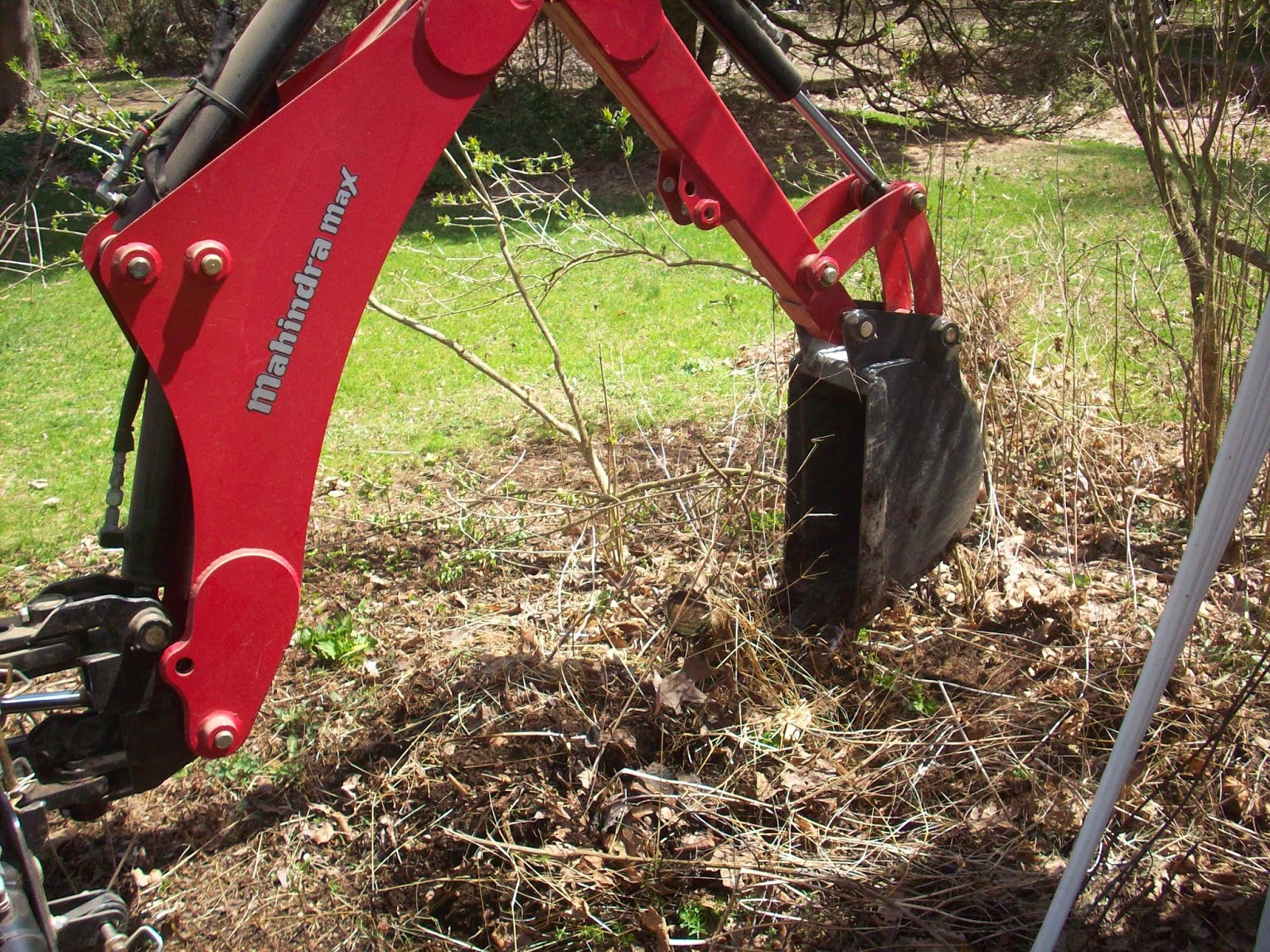
Tractor Work
Today the tractor got a good work out.
It dug holes for my fruit trees...
Scraped out an old stump...
And pulled out a yew bush the deer killed. It even took out a couple of lilac bushes that were in the way. (All the years at the old house I longed for a large lilac bush. Now, at the new house, I have so many I am pulling them out!)
The lambs thought the holes were useful. If they stood in a hole they didn't have to lean over to eat grass!
It dug holes for my fruit trees...
Scraped out an old stump...
And pulled out a yew bush the deer killed. It even took out a couple of lilac bushes that were in the way. (All the years at the old house I longed for a large lilac bush. Now, at the new house, I have so many I am pulling them out!)
The lambs thought the holes were useful. If they stood in a hole they didn't have to lean over to eat grass!
Saturday, April 4, 2015
Planning the Orchard
The fruit trees I ordered this winter should be shipping next week. So, it's time to figure out exactly where they will be planted. I have been studying high density planting for fruit trees and found a few interesting videos: High Density Planting for Fruit Trees and High Density Fruit Tree Growing.
The first video is helpful in seeing the trees as they are planted and the second video shows mature trees and how they look when pruned to stay small.
Deep Green Permaculture has a nice article on backyard orchard culture with lots of diagrams on different planting layouts. I think the hedgerow plan would work best with the slope of my orchard space.
I have four apple trees, two pear trees, a columnar self fertile peach tree and a crabapple tree going in the orchard; and possibly a sour cherry tree. I remember it was a lot of fun picking out the apple trees. How could I pass up a "Sheep Nose" apple tree!
So the plan, I think, will look like this:
The two Johnagolds are at the top of the orchard and I still haven't made up my mind as to whether or not they will stay. They seem to have more buds on them this year so we'll see how they have recovered after last year's buffet by the deer. Right now the chickens are wintering in the upper orchard but will have to go somewhere else soon.
The first video is helpful in seeing the trees as they are planted and the second video shows mature trees and how they look when pruned to stay small.
Deep Green Permaculture has a nice article on backyard orchard culture with lots of diagrams on different planting layouts. I think the hedgerow plan would work best with the slope of my orchard space.
I have four apple trees, two pear trees, a columnar self fertile peach tree and a crabapple tree going in the orchard; and possibly a sour cherry tree. I remember it was a lot of fun picking out the apple trees. How could I pass up a "Sheep Nose" apple tree!
So the plan, I think, will look like this:
The two Johnagolds are at the top of the orchard and I still haven't made up my mind as to whether or not they will stay. They seem to have more buds on them this year so we'll see how they have recovered after last year's buffet by the deer. Right now the chickens are wintering in the upper orchard but will have to go somewhere else soon.
Monday, January 12, 2015
The Orchard
Last winter with horrible weather the deer used my apple trees as a snack bar. Consequently, we harvested about five apples. The growth they put on last summer should get us a better harvest next fall, but not if the deer return to eat. Enter the three wire electric fence.
Our latest project over the past few weeks has been to fence in the area that will be the new orchard. This area encompasses the existing apples trees and heads down the south-east facing slope in a roughly 43x37 foot rectangle. Alan hooked up the fence last night to the energizer and the meter pegged out at greater than 8,000 volts. Watch out deer!
With orchard area now defined I ordered some heirloom apple trees, a self fertile peach tree, two pear trees and a crab apple tree. Computer time has been used up reading all about organic orcharding and management.
Our latest project over the past few weeks has been to fence in the area that will be the new orchard. This area encompasses the existing apples trees and heads down the south-east facing slope in a roughly 43x37 foot rectangle. Alan hooked up the fence last night to the energizer and the meter pegged out at greater than 8,000 volts. Watch out deer!
With orchard area now defined I ordered some heirloom apple trees, a self fertile peach tree, two pear trees and a crab apple tree. Computer time has been used up reading all about organic orcharding and management.
Sunday, November 16, 2014
Winter Fig Care
It's time for the fig trees to move to their winter quarters, the barn.
Fig trees can be winter hardy, with a little protection, not too far south from us. But I would just kill them if I kept them outside in our winters. So they will have a cozy spot in the back corner of the barn until it's time to get them started again in the spring.
This pretty simple article on fig tree care in winter recommends watering the fig trees once a month. The hard part will be remembering to do that!
Fig trees can be winter hardy, with a little protection, not too far south from us. But I would just kill them if I kept them outside in our winters. So they will have a cozy spot in the back corner of the barn until it's time to get them started again in the spring.
This pretty simple article on fig tree care in winter recommends watering the fig trees once a month. The hard part will be remembering to do that!
Wednesday, November 13, 2013
The old apple trees
Despite their lack of care this year, our two apples trees gave us close to a bushel of apples. I pruned them drastically last March, but they need even more pruning.
Both trees have fallen way over and are being supported by their branches on the ground. These branches on the ground made it very difficult to keep the grass cut underneath the trees. And are probably a nice highway up the tree for insects as well.
The first tree, closest to the house, fell over in Sandy. I am thinking of cutting and propping up as below in yellow.
The other tree, which started leaning many years before we moved here, has an even steeper lean. But the end result, I am hoping, could be the same.
This tree outperformed the other tree by at least 2:1 this year. And we were happy with the taste of the apples so I think it is worth the effort to try to rejuvenate them.
Both trees have fallen way over and are being supported by their branches on the ground. These branches on the ground made it very difficult to keep the grass cut underneath the trees. And are probably a nice highway up the tree for insects as well.
The other tree, which started leaning many years before we moved here, has an even steeper lean. But the end result, I am hoping, could be the same.
This tree outperformed the other tree by at least 2:1 this year. And we were happy with the taste of the apples so I think it is worth the effort to try to rejuvenate them.
Subscribe to:
Posts (Atom)